The collection
The masterpieces worth crossing the building for
Roughly 35,000 objects are on display. Perhaps fifteen justify walking a long way. Here they are, with the wing and floor to find each one — and the famous paintings that are not here at all, however confidently the internet says otherwise.
Written by Marc Feuillet Updated
Highlights tours of the Louvre
See live pricesAt a glance
- On display
- Roughly 35,000 objects across three wings
- The wings
- Denon, Sully, Richelieu
- Leonardos
- Five — the largest group anywhere
- Collection ends
- About 1848; later work is at the Musée d’Orsay
- Realistic
- 10–15 works in three hours
- Quietest greats
- Galerie d’Apollon, Cour Marly, Near Eastern antiquities
How the building is organised
Three wings around the Cour Napoléon, each several floors deep. Knowing which is which saves more walking than any other single fact about the museum.
- Denon — Italian painting, the large French nineteenth-century canvases, the Winged Victory, the Galerie d’Apollon. The busiest wing by a wide margin.
- Sully — Egyptian antiquities, Greek sculpture including the Venus de Milo, and the medieval foundations of the original fortress in the basement.
- Richelieu — Near Eastern antiquities, Northern European painting, French sculpture in the glass-roofed courtyards, and the Napoleon III apartments. Consistently the quietest.
The fifteen worth the walk
Sculpture and antiquities
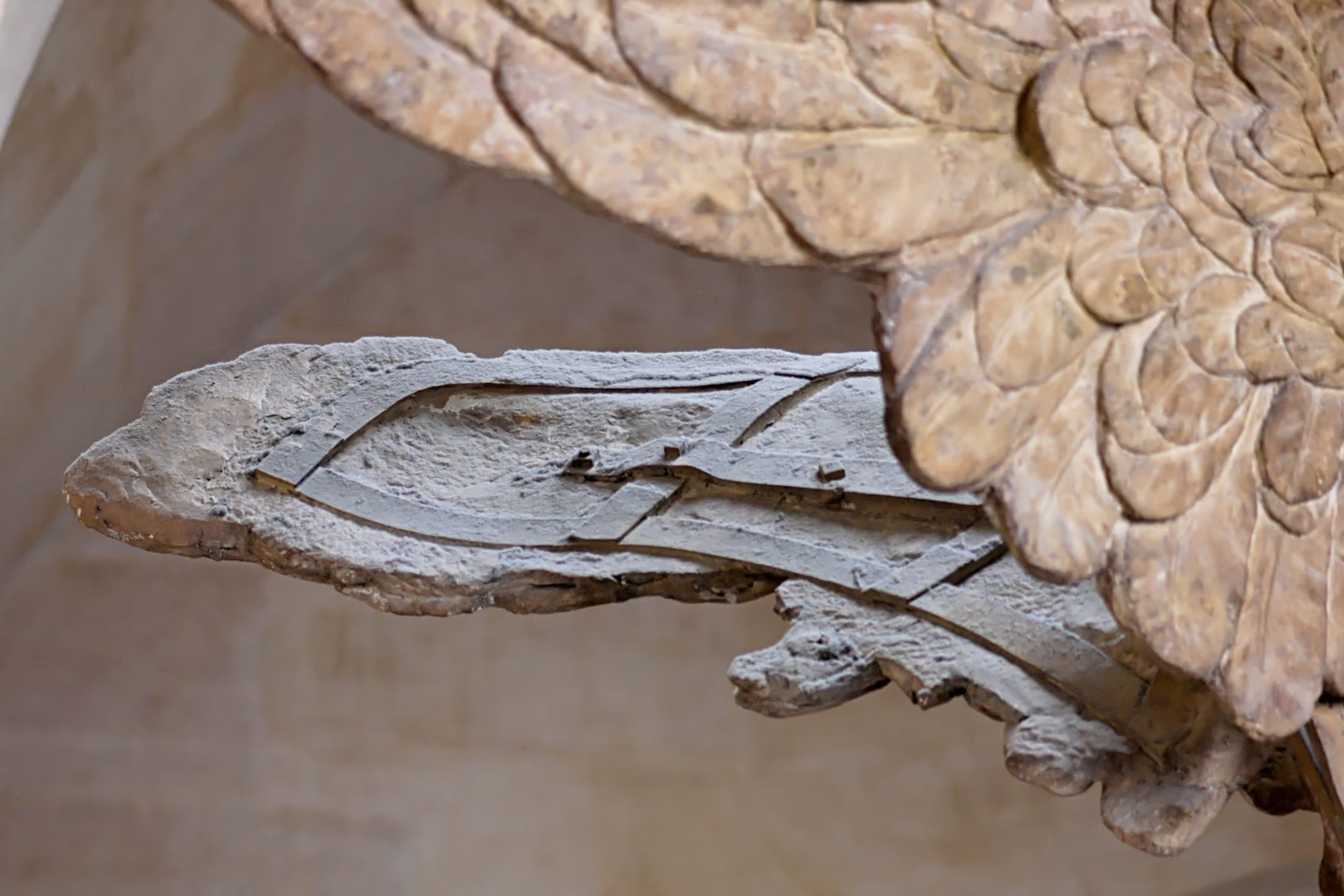
- Winged Victory of Samothrace — Denon, at the top of the Daru staircase. Carved around 190 BC, headless, and still the most dramatic object in the museum. It was made to stand on the prow of a ship and the marble drapery genuinely reads as wet cloth in wind. Approach it up the stairs, not from the side.
- Venus de Milo — Sully, ground floor. Around 130–100 BC. Smaller in reputation than in person: it is over two metres tall. The crowd is real but nothing like the Salle des États.
- Code of Hammurabi — Richelieu, ground floor. A black basalt stele from about 1750 BC carved with one of the earliest substantial law codes. Almost always quiet, and arguably the single most historically important object in the building.
- Winged bulls of Khorsabad — Richelieu. Assyrian guardian figures on a scale that no photograph conveys. Children stop dead in front of them.
- Great Sphinx of Tanis — Sully, Egyptian antiquities. Granite, enormous, and the anchor of the department everyone under twelve enjoys most.
- Sarcophagus of the Spouses — Etruscan, a reclining couple on a terracotta couch, sixth century BC. Note that the better-known version is in Rome; the Louvre’s is a second example from the same workshop tradition and is easy to see.
Painting
- Mona Lisa — Denon, Salle des États. Covered in detail on its own page, including the timing that makes it bearable.
- The Wedding at Cana, Veronese — the opposite wall of the same room, nearly ten metres wide, the largest painting in the museum, and viewed by almost nobody.
- Liberty Leading the People, Delacroix — Denon, first floor. Cleaned in 2024 and transformed by it. See the full page.
- The Raft of the Medusa, Géricault — same rooms. Seven metres wide, based on a real 1816 shipwreck and a genuine political scandal. Stand well back.
- The Coronation of Napoleon, David — same rooms again. Roughly ten metres across. Napoleon crowning Joséphine, having just crowned himself.
- La Belle Ferronnière, attributed to Leonardo — Grande Galerie. The attribution has been argued for a century. The sitter’s sideways glance is the most alive thing in the corridor and you will usually have it to yourself.
- Saint John the Baptist, Leonardo — Denon. The last painting he is thought to have worked on, and unsettling in a way the Mona Lisa is not.
- The Death of the Virgin, Caravaggio — Denon. Rejected by the church that commissioned it: the Virgin is unmistakably a real corpse, swollen and barefoot. It is the most confrontational painting in the museum.
- The Lacemaker, Vermeer — Richelieu. Twenty-four centimetres tall. After three hours of ten-metre canvases the change of scale lands hard.
Rooms that are themselves the exhibit
- Galerie d’Apollon — Denon, first floor. The French crown jewels under a ceiling by Charles Le Brun, with a central panel painted by Delacroix. Gilded to the point of absurdity and routinely walked past.
- Napoleon III apartments — Richelieu. Preserved state rooms: chandeliers, red silk, and almost no visitors. The best quiet twenty minutes in the museum.
- Medieval Louvre — Sully, basement. The foundations of the twelfth-century fortress, excavated and walkable. See the history page.
Famous works that are not at the Louvre
A surprising share of Louvre searches are for objects somewhere else entirely. Saving you the walk:
| Where it actually is | Why people expect it here | |
|---|---|---|
| Any Van Gogh | Musée d’Orsay, Paris (and worldwide) | The Louvre’s collection stops around 1848. There is no Van Gogh here at all. |
| The Starry Night | Museum of Modern Art, New York | Assumed to be with “the famous paintings”. |
| The Thinker | Musée Rodin, Paris | Rodin is nineteenth-century and has his own museum. |
| Antea, by Parmigianino | Museo di Capodimonte, Naples | A large Capodimonte loan exhibition at the Louvre linked the two in search results. |
| The Birth of Venus | Uffizi, Florence | Botticelli confusion with the Louvre’s Italian holdings. |
| The Last Supper | Santa Maria delle Grazie, Milan | It is a wall painting and cannot be moved. |
The Van Gogh point is worth repeating because it is the most common single mistake visitors make about this museum. If Impressionism and Post-Impressionism are why you came to Paris, the Musée d’Orsay is the museum you want — fifteen minutes on foot across the river, and a far better use of an afternoon than hunting for something the Louvre never had.
Tours that actually reach these
Most two-hour tours cover four or five of the works above. Anything promising twenty in ninety minutes is describing a walk past them. Checked in August 2026.
-
01
Mona Lisa & Louvre Masterpieces Tour with Reserved Access
Longest-running Louvre product on the platform. Duration varies by the option you pick at checkout.
-
02
Louvre Museum Tour: Mona Lisa & Iconic Masterpieces
Meets at the Kiosque des Noctambules, not under the pyramid. Runs in English, German, Italian, Spanish and Portuguese.
-
03
Reserved Access: Guided Louvre Museum Tour with an Expert
Certified by GetYourGuide. The volume option for people who want a guide but not a private budget.
-
04
Best of the Louvre Guided Tour with Pre-booked Ticket
Highest-rated Louvre tour on the platform with a four-figure review count. Private option available.
Prices checked Aug 2026.
Questions people actually ask
Does the Louvre have any Van Gogh paintings?
No. Not one. The Louvre’s collection stops around 1848, and everything later went to the Musée d’Orsay when it opened in 1986. For Van Gogh in Paris, go to the Orsay — it is fifteen minutes away across the river.
What are the must-see works at the Louvre?
The Winged Victory of Samothrace, the Venus de Milo, the Mona Lisa, Delacroix’s Liberty Leading the People, Géricault’s Raft of the Medusa, David’s Coronation of Napoleon, the Code of Hammurabi and the Great Sphinx of Tanis. That is a solid three hours and covers all three wings.
Which Leonardo da Vinci paintings are in the Louvre?
Five, the largest group anywhere: the Mona Lisa, the Virgin of the Rocks, the Virgin and Child with Saint Anne, La Belle Ferronnière, and Saint John the Baptist. Four of them hang in the Grande Galerie and are almost always quiet.
Is La Belle Ferronnière by Leonardo?
It is attributed to Leonardo, though the attribution has been argued over for a century and workshop involvement is possible. It hangs in the Grande Galerie, a short walk from the Mona Lisa, and you can usually stand alone in front of it.
Are there Caravaggio paintings in the Louvre?
Yes, including The Death of the Virgin and The Fortune Teller. The Death of the Virgin was rejected by the church that commissioned it, reportedly because the model for the Virgin was too plainly a real, dead woman.
Where is the Portrait of a Young Girl called Antea?
Not at the Louvre. Parmigianino’s Antea belongs to the Museo di Capodimonte in Naples. The confusion is understandable — a large group of Capodimonte paintings was lent to the Louvre for a major exhibition, and search results have associated the two ever since.
Can you see the Galerie d’Apollon?
Yes, it is part of the normal visit, on the first floor of the Denon wing near the Italian paintings. It houses the French crown jewels beneath a ceiling by Charles Le Brun and a central panel painted by Delacroix. Most visitors walk past the door.
What can I see in the Louvre in one hour?
Three things, honestly. Enter at the Carrousel, take the Daru staircase to the Winged Victory, walk the Grande Galerie to the Mona Lisa, and leave through the French painting rooms past Liberty Leading the People. Anything more in an hour is a corridor tour.
Read next
-
Mona Lisa
The one everybody comes for, and what the visit is really like.
-
Liberty Leading the People
Delacroix’s 1830 canvas after its 2024 cleaning.
-
Louvre visitor guide
A three-hour route that strings these together sensibly.
-
Hours, entrances, getting there
Which entrance and which floor, so you do not walk the building twice.
-
Evening & after-hours
The evening slot, when the big rooms empty.
Sources
- Musée du Louvre Departments, wings and current room information. Checked 26 August 2026.
- Louvre collections database Catalogue entries, dates, dimensions and attributions.
Photo credits
- Venus de Milo Louvre Ma399 n4 — Unknown artistUnknown artist, Public domain, via Wikimedia Commons
- Wing victory Samothrace Louvre Ma2369 — Unknown artistUnknown artist, Public domain, via Wikimedia Commons
- Louvre - Galerie d Apollon - Tapis — Faqscl, CC BY-SA 4.0, via Wikimedia Commons
- Grande Galerie, Louvre Museum, 25 September 2019 01 — Cheng-en Cheng from Taichung City, Taiwan, CC BY-SA 2.0, via Wikimedia Commons
Where things live
- Denon
- Italian painting, French large formats, Winged Victory
- Sully
- Egyptian antiquities, Venus de Milo, medieval Louvre
- Richelieu
- Near East, Napoleon III apartments, Northern painting
- Check daily
- Room closures are posted at the entrance