The building
Fortress, palace, museum: how the Louvre happened
The Louvre was a defensive keep for two centuries before it was a palace, a palace for three centuries before it was a museum, and an abandoned building site in between. Every one of those layers is still visible if you know which floor to stand on.
Written by Marc Feuillet Updated
Tours covering the palace and its history
See live pricesAt a glance
- Fortress begun
- c. 1190, under Philippe Auguste
- Became a residence
- Fourteenth century, under Charles V
- Renaissance palace
- From 1546, architect Pierre Lescot
- Court leaves
- 1682, Louis XIV moves to Versailles
- Opens as a museum
- 10 August 1793
- Pyramid completed
- 1989, architect I. M. Pei
A castle nobody wanted to live in (1190–1364)
Around 1190, Philippe Auguste was preparing to leave on crusade and worried about the western approach to Paris. He built a fortress outside the city wall: a rectangular enclosure with a circular keep at its centre, a moat, and no pretension to comfort. It was a military structure with a treasury and an archive.
The city grew past it within a century, and the fortress lost its purpose. In the 1360s Charles V converted it into a residence — windows, gardens, a library in one tower. It was a royal address rather than a royal home, and the court still preferred the Île de la Cité.
The palace that was never finished (1546–1682)
In 1546 François I demolished the old keep and commissioned Pierre Lescot to build something in the new Italian manner. That decision set the pattern for the next three hundred years: every monarch demolished part of what the last one built and started a wing of their own.
- Catherine de’ Medici began the separate Tuileries Palace to the west in 1564.
- Henri IV built the Grande Galerie along the river to connect the two — a quarter-mile corridor that is now full of Italian paintings.
- Louis XIII and Louis XIV quadrupled the Cour Carrée and added the eastern colonnade.
Then in 1682 Louis XIV moved the court to Versailles, and work simply stopped. The Louvre spent the next century as a half-built shell occupied by the royal academies, working artists, and a population of squatters who put chimneys through the walls. There were serious proposals to demolish it.
The Revolution opens the doors (1793)
On 10 August 1793, one year to the day after the fall of the monarchy, the Louvre opened as the Muséum central des arts. The collection was the confiscated royal holdings plus property seized from the church and from émigré aristocrats.
The idea behind it was genuinely radical: that the finest objects a state possessed belonged to the public and should be looked at for free by anyone. Nearly every national museum in the world descends from that argument.
Under Napoleon the collection expanded by conquest, and for a period the museum carried his name. A substantial part of what had been taken was returned after 1815, but not all of it — a provenance question the museum still works through today.
Second Empire, and a fire (1852–1871)
Napoleon III finally closed the gap between the Louvre and the Tuileries in the 1850s and 60s, completing the Cour Napoléon and building the state apartments that survive in the Richelieu wing — the most complete Second Empire interiors in Paris, and among the emptiest rooms in the museum.
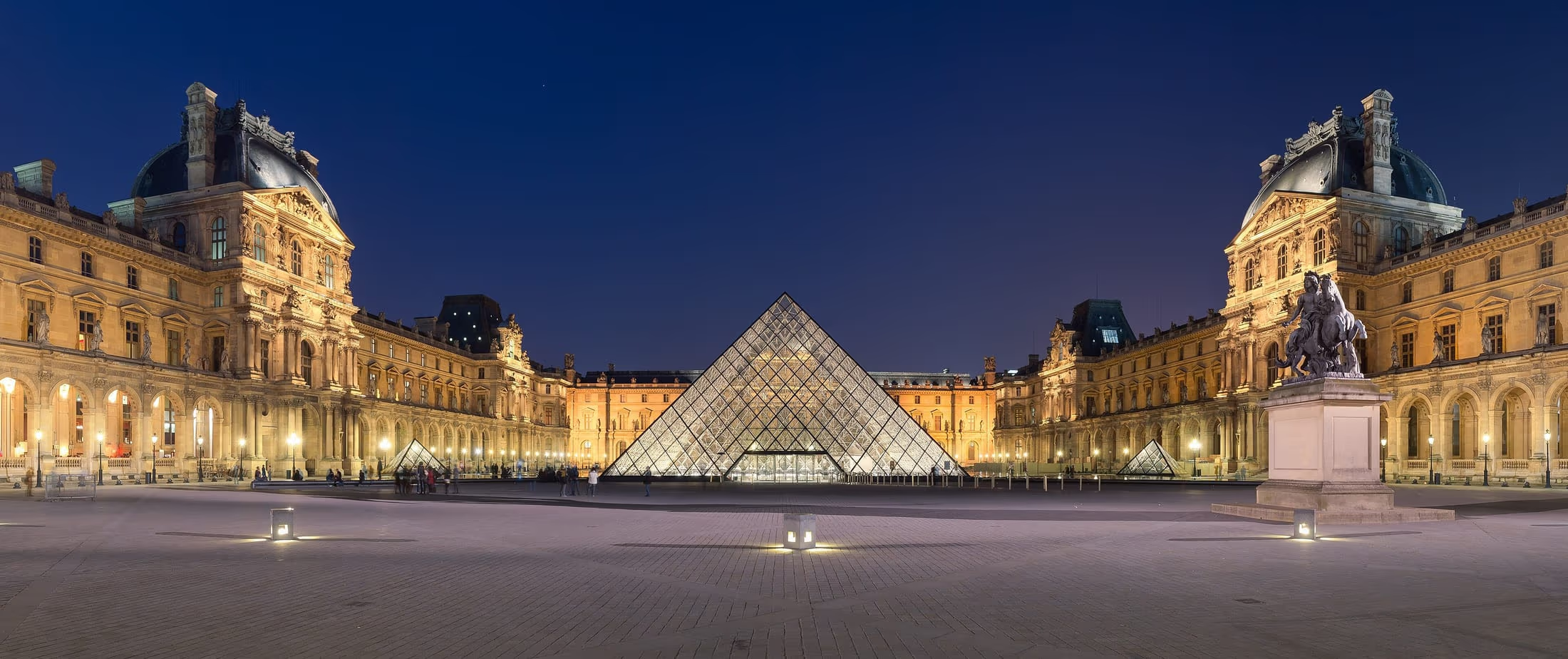
In May 1871, during the suppression of the Paris Commune, the Tuileries Palace was set alight and gutted. The ruins stood for a decade before being cleared. That is why the Louvre today is a U rather than a rectangle: the fourth side burned down and was never replaced. Stand in the Cour Napoléon facing the Tuileries garden and you are looking at the footprint of a missing palace.
The Grand Louvre and the pyramid (1981–1993)
By 1980 the museum had a real problem. It received millions of visitors through a set of small doors with no central hall, no cloakroom worth the name and no room to expand — and the Ministry of Finance still occupied the entire Richelieu wing.
President Mitterrand’s Grand Louvre project solved both. The finance ministry moved to Bercy, freeing a third of the building for galleries, which opened in 1993. And the architect I. M. Pei put the reception hall underground beneath the Cour Napoléon, roofing it with a glass pyramid completed in 1989.
The pyramid was loathed on arrival — too modern, too Egyptian, too much glass in a historic courtyard. It is now the museum’s emblem, which is a reasonably common trajectory for Paris landmarks. The argument for it was practical rather than symbolic: it lights a large basement without putting a solid building in the middle of the view.
The excavation for that basement is how the medieval fortress reappeared. Digging out the reception hall exposed the base of Philippe Auguste’s keep and its moat, which were conserved in place and are now on display.
Where to see each layer
Do it in this order and the building tells its own story in about forty minutes.
- Sully, basement. The medieval Louvre — the keep base and moat walls, c. 1190. Quiet, cool, and almost nobody comes down.
- Cour Carrée, west range. Lescot’s Renaissance facade of 1546. Free to walk into; no ticket needed.
- Grande Galerie, Denon. Henri IV’s river corridor, now the Italian painting gallery.
- Galerie d’Apollon, Denon. Le Brun’s ceiling for Louis XIV, with a nineteenth-century central panel by Delacroix — the two ends of French decorative ambition in one room.
- Napoleon III apartments, Richelieu. The Second Empire at full volume.
- Cour Napoléon. Step outside and look at Pei’s pyramid, then west at the gap where the Tuileries stood.
Why the history is useful, not just interesting
Visitors who understand the building navigate it better. The Denon wing is crowded because it contains Henri IV’s long gallery and the Salle des États, and long galleries funnel people. Richelieu is empty because it was a government ministry until 1993 and has never been on the standard route. Sully holds the antiquities because that is where the oldest, thickest walls were.
None of that is arbitrary, and knowing it is worth more than a list of must-see objects. If you want a route that uses it, the visitor guide follows the building rather than the greatest hits.
Tours that cover the palace, not just the paintings
Checked in August 2026.
-
01
Louvre Overview, Exploration Tour and Reserved Entry
The cheapest guided way in, and the most reviewed. The guide orients you and leaves; you keep the museum for the rest of the day.
-
02
Reserved Access: Guided Louvre Museum Tour with an Expert
Certified by GetYourGuide. The volume option for people who want a guide but not a private budget.
-
03
Best of the Louvre Guided Tour with Pre-booked Ticket
Highest-rated Louvre tour on the platform with a four-figure review count. Private option available.
Prices checked Aug 2026.
Questions people actually ask
When was the Louvre built?
Construction began around 1190, when Philippe Auguste raised a defensive fortress on the western edge of Paris before leaving on crusade. Almost nothing above ground survives from that building, but its foundations were excavated in the 1980s and you can walk around them in the Sully basement.
Who built the Louvre?
No one person. Philippe Auguste built the fortress around 1190; Charles V turned it into a residence in the fourteenth century; François I began the Renaissance palace in 1546 with the architect Pierre Lescot; and roughly twenty monarchs and two republics added to it after that. The glass pyramid is by I. M. Pei, completed in 1989.
When did the Louvre become a museum?
On 10 August 1793, during the French Revolution, when it opened as the Muséum central des arts. The collection was largely the confiscated royal and aristocratic holdings, which is why a national museum ended up inside a royal palace.
Why did the kings leave the Louvre?
Louis XIV moved the court to Versailles in 1682. The Louvre was left half-finished and gradually filled with artists, academies and squatters — a state it remained in for over a century, which is one reason the Revolution found it available.
Why is there a glass pyramid at the Louvre?
Because the museum had no proper entrance. By the 1980s visitors arrived through several small doors with no central hall. The Grand Louvre project put a single underground reception beneath the courtyard, and the pyramid is its roof — a way to light a basement without building anything solid in a historic courtyard.
What happened to the Tuileries Palace?
It burned during the Paris Commune in 1871 and its ruins were demolished a decade later. That is why the Louvre opens westward onto a garden instead of closing into a courtyard — the fourth side of the complex is simply missing.
Can you see the original medieval fortress?
Yes. The excavated base of Philippe Auguste’s keep and its moat walls are on display in the Sully basement, included in normal admission. It is one of the quietest parts of the museum and the best twenty minutes for understanding the building.
Read next
-
Louvre visitor guide
A route through the building that follows its chronology.
-
Masterpieces to find
What ended up inside, and where it lives now.
-
Hours, entrances, getting there
Hours, entrances and how to reach the Sully basement first.
-
Liberty Leading the People
A revolution painted eighteen years before the museum’s own upheavals.
Sources
- Musée du Louvre Official history of the palace and museum. Checked 26 August 2026.
- Louvre collections database Provenance records for the founding collections.
Photo credits
- Louvre Museum Wikimedia Commons — Benh LIEU SONG (Flickr), CC BY-SA 3.0, via Wikimedia Commons
- Napoleon III apartments (31289567722) — Fred Romero from Paris, France, CC BY 2.0, via Wikimedia Commons
- Louvre aile Richelieu — Jebulon, CC0, via Wikimedia Commons
Layers to find
- Medieval keep
- Sully basement — walk the moat
- Renaissance facade
- Cour Carrée, west range
- Second Empire
- Napoleon III apartments, Richelieu
- Missing wing
- Tuileries, burned 1871