Operator review
Context Travel: is it worth booking?
An international operator built on a single stated principle: understanding beats coverage. It fields art historians, curators and doctorate holders, charges accordingly, and will happily spend twenty minutes on one painting while other groups walk past.
Written by Claire Benoit Updated
Compare against tours booking now
See live pricesAt a glance
- Format
- Tour agency
- Group size
- Private, or shared groups capped in single figures
- Price band
- Premium
- Where to book
- Direct on contexttravel.com
- Website
- contexttravel.com
- Found via
- Web search, Rick Steves forum
The proposition
Context Travel sells a deliberately narrow product. Its guides are recruited as scholars first — art historians, archaeologists, museum curators, people with doctorates in the material — and the itineraries are designed around ideas rather than around famous objects.
At the Louvre this produces two characteristic products: a Crash Course that orients you and hands the museum back, and Highlights with an Art Historian, which despite the name covers fewer works than most highlights tours and says more about each.
The company is explicit that it does not attempt to cover the museum. That honesty is the strongest thing about it and the reason some visitors come away disappointed — they bought a seminar and expected a tour.
What the credentials actually change
Guide quality is the least verifiable claim in this industry, so it is worth being concrete about what a scholar-guide does differently.
- They answer follow-up questions. A scripted guide can deliver a good ten minutes on the Mona Lisa and then has nothing further. A specialist can be asked why the panel is poplar, what happened during the 2019 conservation examination, why the attribution of La Belle Ferronnière is disputed — and will have a real answer.
- They disagree with the consensus. Genuine expertise includes opinions about contested attributions and dating. Hearing a guide say “most people say this, and I think they are wrong, because —” is the clearest signal you are getting your money’s worth.
- They edit ruthlessly. Ask a Context guide what they would skip and you get a considered answer, because they have thought about what two hours can actually hold.
What it costs, honestly
This is the premium end of the Paris market and the company does not pretend otherwise. Pricing is per group, so the arithmetic changes sharply with party size: a fee that looks impossible for two people becomes competitive with a good semi-private tour once you are four or five, while buying a substantially better guide.
Compare it against the right thing. Context is not competing with a €40 orientation tour and should not be judged against one. It competes with hiring an independent licensed art historian directly — where you pay less but do the vetting yourself, and carry the risk if the guide falls ill.
Where it is the wrong choice
Be honest with yourself about the visit you want. Context is a poor fit for:
- Young children. The format assumes sustained attention. For families, Paris Muse or a treasure-hunt operator is a much better use of the same money.
- A single free morning in Paris. If the Louvre is one stop on a busy day, a shorter, faster tour serves you better than a deep one.
- Anyone who wants the famous objects photographed. You will see fewer of them, by design.
- Flexible plans. Agency cancellation terms are stricter than the 24-hour free-cancellation standard on the booking marketplaces.
The realistic recommendation
Book Context if the guide is the product you are buying and you intend to talk to them. Ask in advance about the assigned guide’s specialism and say what interests you — the whole advantage of this model is a route built around a subject, and visitors who do not brief the operator get a generic version of a specialist service.
What it is good at, and where to be careful
Best for
- Visitors with an art-history background
- Anyone who wants to spend an hour on four paintings
- Solo travellers happy in a small shared group
Watch for
- Among the highest per-group prices in Paris
- Deliberately does not attempt to “cover” the museum
How it compares
Every operator on this site is judged on the same four things: real group size, guide credentials, whether museum admission is included, and how much evidence sits behind the reputation. All thirty operators, ranked into tiers. Every private format compared, with the crossover points.
Booking through a marketplace instead gives you free cancellation up to 24 hours on most products, which agencies rarely match. The platforms these operators sell through. Some links to tours and tickets are affiliate links. If you book through them we may earn a commission, at no extra cost to you. It never changes what we recommend.
Questions people actually ask
Is Context Travel worth it?
If you engage with the guide, yes — you are buying access to an art historian or curator, and the difference over a standard tour is obvious within twenty minutes. If you want a checklist of famous objects photographed efficiently, you are paying a premium for something you did not want.
Are Context Travel guides really PhDs?
The company recruits on academic and curatorial credentials and states this openly. Not every guide holds a doctorate, but the floor on subject knowledge is much higher than the market average, and you can ask about a specific guide’s background before booking.
How much does a Context Travel Louvre tour cost?
Among the highest per-group prices in Paris. They price the expertise rather than the seat, so a party of four or five brings the per-head cost down close to a good semi-private tour while buying a considerably better guide.
What is the Louvre Crash Course?
Their orientation product: a shorter session designed to give you the shape of the museum and the confidence to explore it alone afterwards, rather than to walk you past everything famous.
Context Travel or Take Walks?
Context for depth and academic credentials on a narrower route. Take Walks for a longer, more structured itinerary with a hard group cap and headsets. Context assumes you want to think; Take Walks assumes you want to see.
Read next
Sources
- Context Travel — official site The operator’s own description of its tours and pricing.
- Musée du Louvre Admission prices, opening hours and group access. Checked 26 August 2026.
Photo credits
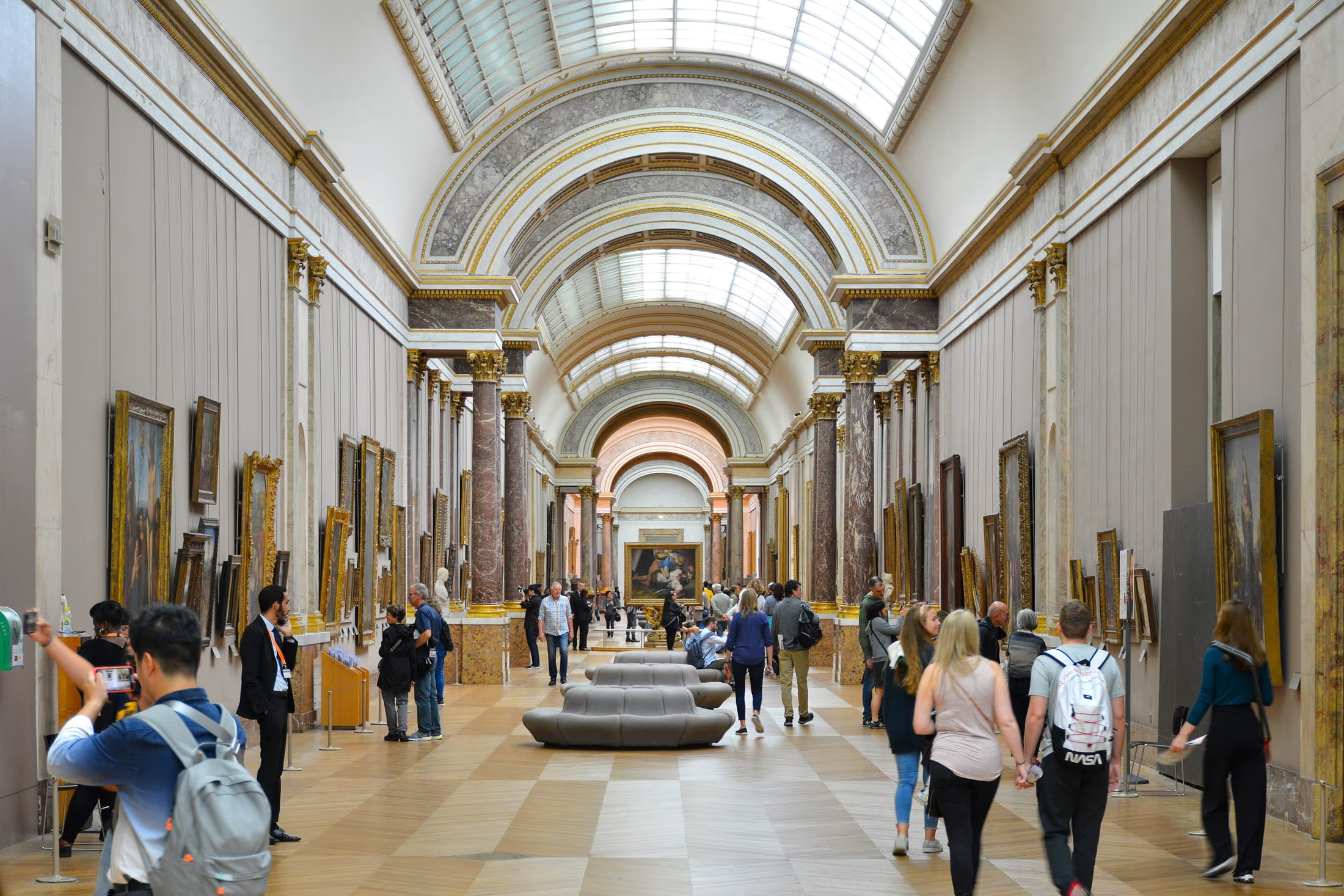
- Grande Galerie, Louvre Museum, 25 September 2019 01 — Cheng-en Cheng from Taichung City, Taiwan, CC BY-SA 2.0, via Wikimedia Commons
Context Travel
- Our shorthand
- Art historians, curators and PhDs; depth chosen over square metres.
- Best for
- Visitors with an art-history background
- Watch for
- Among the highest per-group prices in Paris